


Products & digital solutions · E-commerce & multi-role platforms
In development · Multi-vendor digital marketplace
Rawaj
A marketplace connecting buyers, sellers, and operations from discovery to after-sales
A multi-vendor digital marketplace connecting product discovery, listing creation and moderation, cart and negotiated ordering, and after-sales workflows—including tracking, returns, disputes, and seller ledger accounting—within one structured experience.




Why Rawaj? Bringing scattered transaction steps into one structured flow
In everyday digital commerce, the context of a transaction often breaks across separate channels: a listing is posted on one page, price negotiation happens in a chat thread, an order is agreed upon without a clear state trail, and follow-up becomes ambiguous when a return is requested or seller entitlements are calculated. This fragmentation creates friction for buyers, sellers, and platform operators alike.
I designed and developed Rawaj as a marketplace connecting buyers and sellers. The storefront introduces it with the line “A New Place for Value.” Rather than limiting the product to a catalog and shopping cart, Rawaj models the broader marketplace lifecycle—from listing moderation and order creation to post-delivery returns and accounting records—around role-specific permissions and server-validated state rules.
The Buyer Experience: From product discovery to order tracking
The buyer workspace is structured to provide a clear path across both direct cart purchases and negotiated offers:
- Catalog discovery and product views: Buyers browse the marketplace catalog and inspect product detail pages with imagery, pricing, seller context, and purchase options across responsive mobile and desktop layouts.
- Shopping cart or negotiated offer: The design supports two routes into an order: adding products to a standard cart, or submitting a negotiated offer on a specific unit where an accepted offer proceeds to order review and confirmation before final order creation.
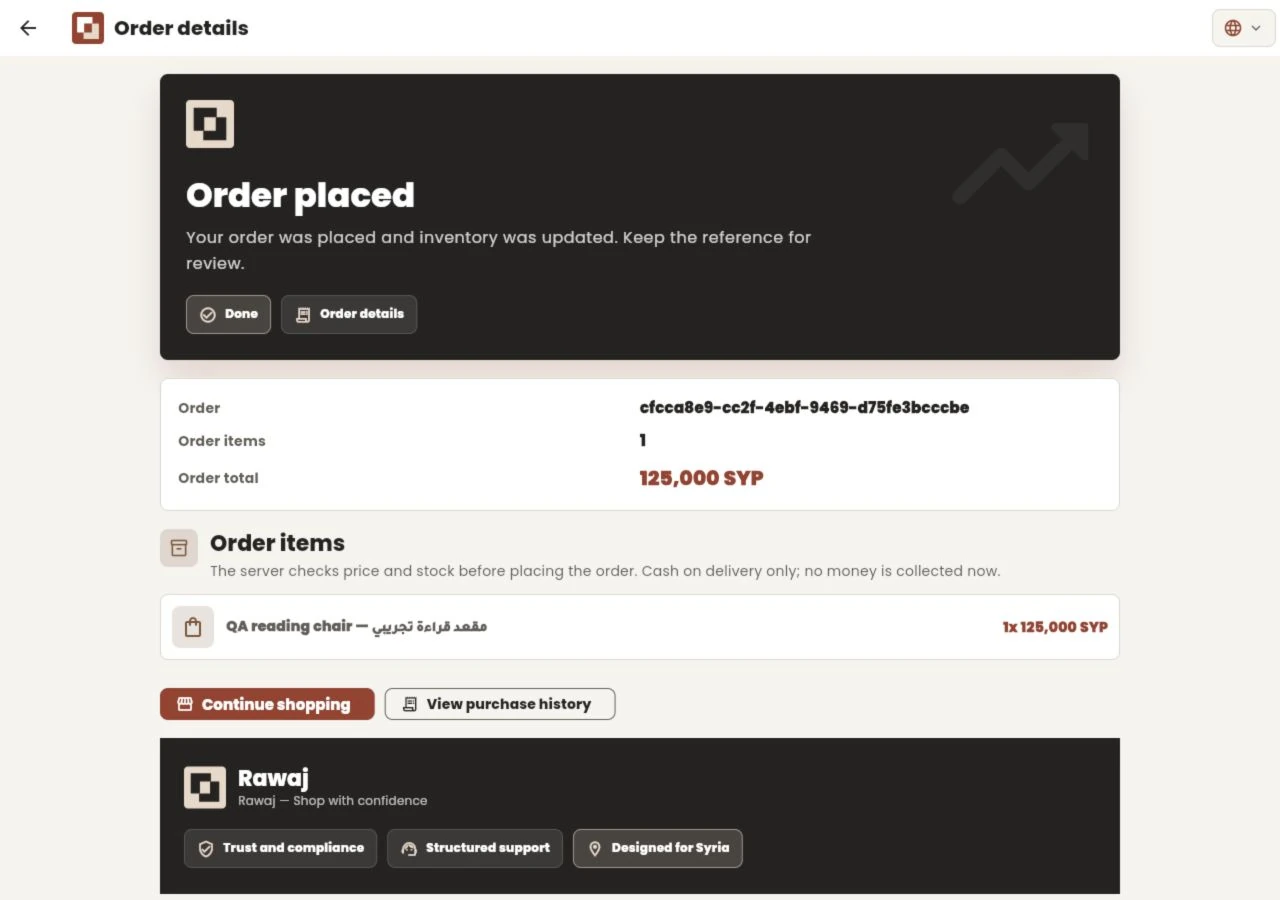
- Order creation and transaction receipt: When an order is confirmed and created, the system records a structured transaction linking buyer and seller and produces a receipt showing items, amounts, and recorded payment status.
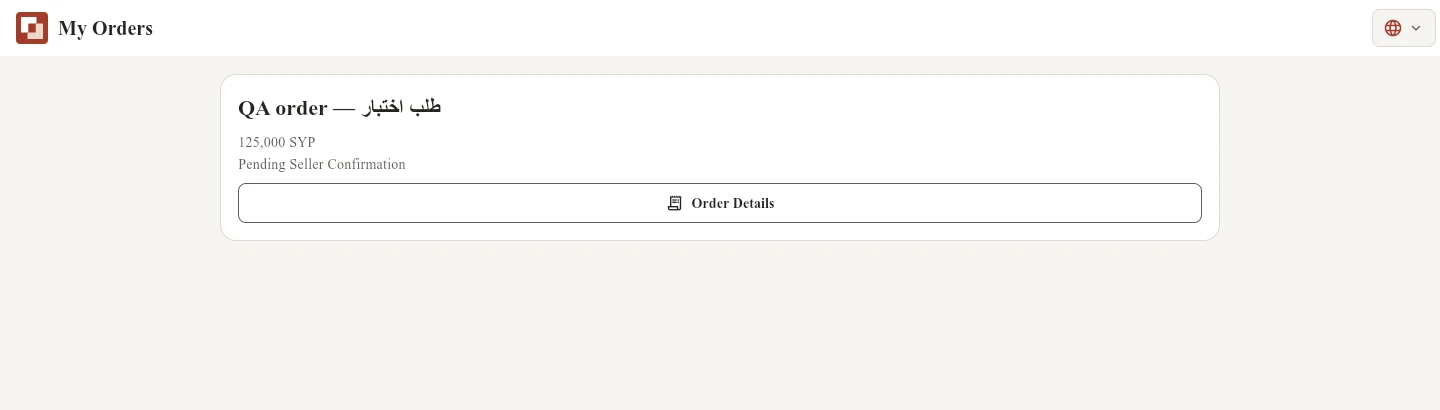
- Order state tracking: In the "My Orders" view, buyers follow recorded order states (awaiting confirmation, preparation, recorded shipping state, or delivery), with rule-checked cancellation available before seller confirmation and cash capture.


The Seller Studio: From private draft to moderated listing
Sellers in a multi-vendor marketplace need a dedicated workspace to prepare listings without exposing unfinished drafts to public visitors. The Seller Studio structures listing publication across five connected steps:
- Listing & Media Setup
- Private Draft
- Editorial Preview
- Submission for Review
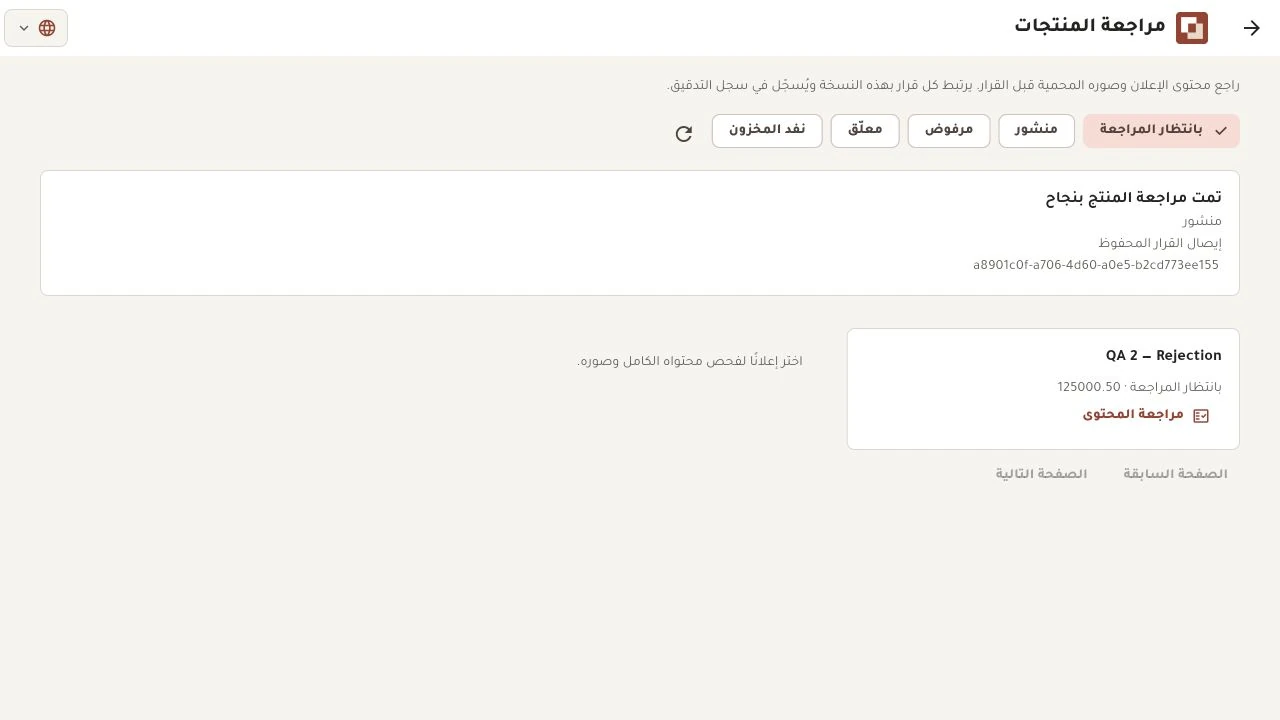
- Moderation Decision & Receipt
- Private draft isolation: Unfinished drafts remain scoped to the seller's workspace until submitted for moderation and approved.
- Clear moderation outcomes: When staff review a listing, the seller sees the resulting state and decision receipt—approved and visible in the catalog, rejected, or suspended with a documented reason—enabling structured edits and resubmission.



One Order, Three Perspectives: Role-aware interfaces
When an order exists in Rawaj, the interface and available actions adapt to the participant's role and the order's current state:
| Participant | Workspace View | State-Governed Actions | System Design Rule |
|---|---|---|---|
| Buyer | Order summary, recorded fulfillment & shipping states, receipt, and post-delivery options. | Follow order status, request cancellation when permitted before confirmation and cash capture, or open a return/dispute after delivery. | Internal seller records stay isolated; action buttons are governed by state-transition rules. |
| Seller | Store orders, confirmation & preparation queues, and linked accounting entitlement records. | Confirm orders, update preparation and recorded shipping states, and submit responses or evidence in return and dispute cases. | Scoped to the seller's own store orders, with state transitions validated against ownership and stage rules. |
| Staff & Administration | Listing moderation queues, dispute files, paginated audit logs, and finance/settlement views. | Approve, reject, or suspend listings with reasons, review disputes, and inspect audit logs and ledger views under granted capabilities. | Audited administrative actions record paginated log entries, and financial view grants are separated from execution grants. |
Buyer
- Workspace View
- Order summary, recorded fulfillment & shipping states, receipt, and post-delivery options.
- State-Governed Actions
- Follow order status, request cancellation when permitted before confirmation and cash capture, or open a return/dispute after delivery.
- System Design Rule
- Internal seller records stay isolated; action buttons are governed by state-transition rules.
Seller
- Workspace View
- Store orders, confirmation & preparation queues, and linked accounting entitlement records.
- State-Governed Actions
- Confirm orders, update preparation and recorded shipping states, and submit responses or evidence in return and dispute cases.
- System Design Rule
- Scoped to the seller's own store orders, with state transitions validated against ownership and stage rules.
Staff & Administration
- Workspace View
- Listing moderation queues, dispute files, paginated audit logs, and finance/settlement views.
- State-Governed Actions
- Approve, reject, or suspend listings with reasons, review disputes, and inspect audit logs and ledger views under granted capabilities.
- System Design Rule
- Audited administrative actions record paginated log entries, and financial view grants are separated from execution grants.
After-Sales & Accounting: Returns, disputes, and seller settlements
Rawaj extends its domain model beyond checkout to organize post-delivery workflows and financial records:
- Return requests and dispute queues: Requesting a return after delivery opens a
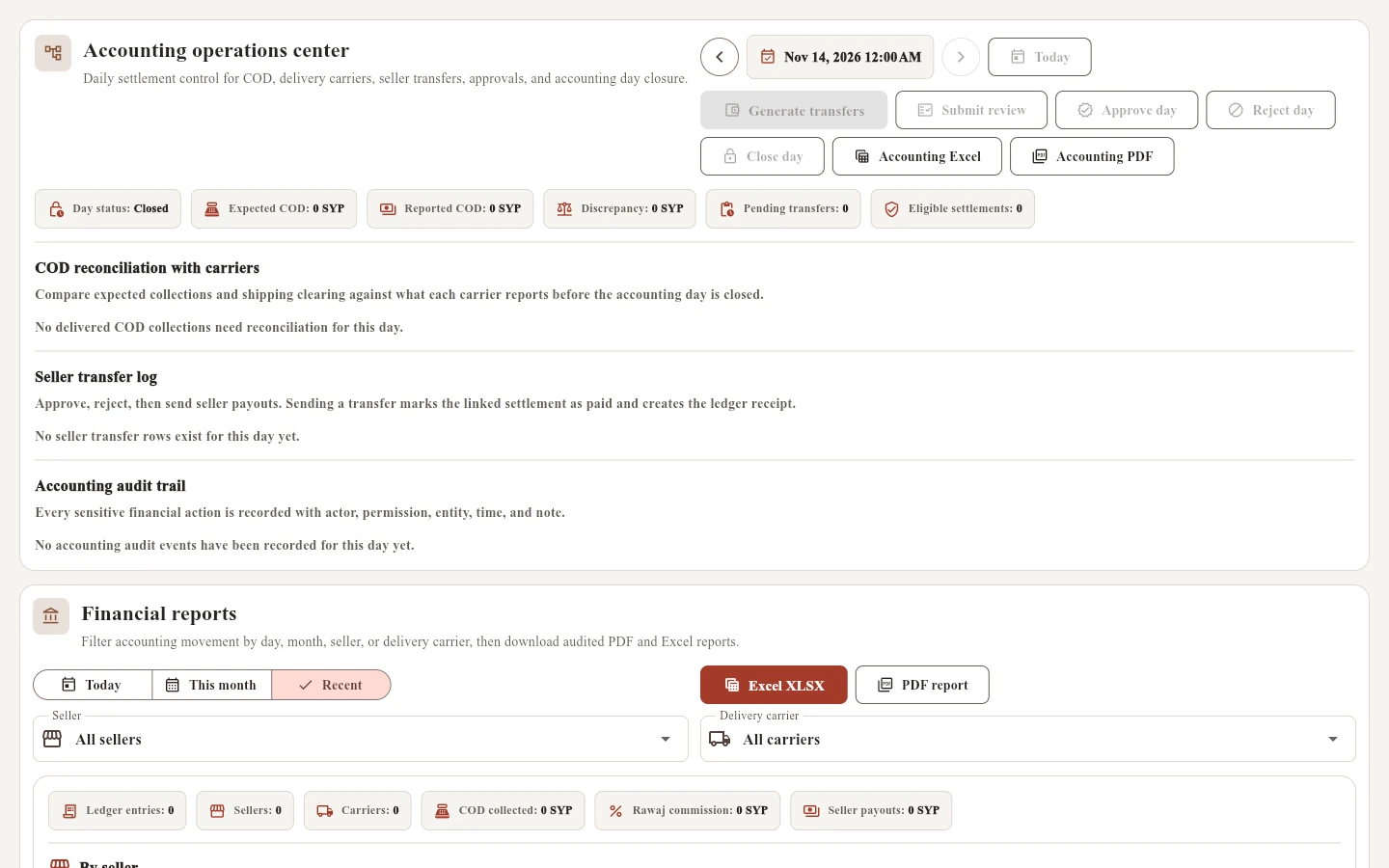
RETURNworkflow linked to a dispute record where participants can attach messages and evidence for administrative review, while keeping the delivery state preserved and without assuming automatic money movement upon request creation. - Accounting settlements and ledger entries: The financial model calculates net seller entitlements by separating platform commission, shipping, and collection fees, linking the resulting record to orders, ledger entries, and receipts. In this project, a settlement means recording the amount owed to a seller in the accounting model (
READYfor processing, orON_HOLDwhen a return request is active); actual external payouts and provider reconciliation are separate stages.
Engineering Behind the Experience: Responsive interfaces and backend guards
I led the application experience design and developed the interfaces, backend services, and data model around four architectural layers:
Multi-platform UI and transition policy (Flutter & Dart)
The interface supports Arabic (RTL) and English (LTR) across web, mobile, and Windows desktop targets. State management is separated from HTTP services, and a client transition policy (order_transition_policy) checks account capabilities and order state to display relevant actions.
- Technical components:
Flutter & Dart·Bloc / Cubitstate management ·DioHTTP client ·order_transition_policyUI state rules.
Backend services, route guards, and audit logging (Node.js, Express & TypeScript)
On protected routes, backend middleware (auth.middleware) checks authentication, account eligibility, role assignments, and granular staff capabilities (such as FINANCE_VIEW for financial read endpoints), while audited administrative actions are recorded in paginated logs.
- Technical components:
TypeScript & Node.js·Express·auth.middlewareguards · Role & capability grants (RBAC / ACL) ·staff-read.serviceaudit log reader.
Four-dimensional order state and PostgreSQL transactions
Order state is represented across four dimensions: transaction state, logistics fulfillment, payment state, and return state. In explicitly composed sensitive transitions, domain services re-verify actor eligibility and record state inside a single PostgreSQL transaction with row-level locking.
- Technical components:
PostgreSQL· SQL migrations & row-level locking ·buyer-transition&seller-transitionservices · Returns & disputes modules.
Supporting infrastructure for caching, real-time channels, and async events
The wider architecture incorporates caching, real-time session and event channels, and an outbox worker design for asynchronous event processing across composed runtime profiles.
- Technical components:
Redis·Socket.IO·Outboxworker design ·Docker Compose.
Rawaj Vision and Current Development State
Rawaj is designed to bring clarity and structure to multi-vendor digital commerce across discovery, ordering, moderation, and post-sale accounting.
The project is in development. Its codebase includes account and permission management, the Seller Studio and moderation workflows, cart and order flows, and components for returns, disputes, and seller ledger accounting. Separate local runs on the web, an Android emulator, and a local Windows package used synthetic data. Across those runs, selected workflows were documented through interfaces connected to the backend and database, including listing publication and moderation, cart flows, login, buyer-order views, and read-only financial views. End-to-end acceptance of the complete commercial journey, live payment collection, refunds, and payouts through an approved provider, and commercial operation remain in progress.
- Context
- Product development
- Maturity
- Active development
- Evidence
- Documented
- Source
- Private source
- Ownership & provenance
- Owner-led work
Technologies
Flutter · Dart · Bloc/Cubit · Dio · TypeScript · Node.js · Express · PostgreSQL · Redis · Socket.IO
Available evidence
Documented frontend, backend, and relational data architecture, supported by genuine interface captures from separate local verification runs using synthetic data across marketplace, buyer, seller, moderation, and read-only finance views on web, mobile, and desktop.