

Lesson
Lesson 7: Protocols, standards and services
Learning goal
After this lesson, you can distinguish seven communication concepts, order evidence from physical connectivity to task success, and explain why a valid protocol error response is not a successful user outcome.
Why this concept matters
A cable can be connected without a meaningful message being exchanged. A structurally valid response can arrive while the intended task still fails. Separating the concepts lets us state what the evidence proves instead of saying only that “the network works.”
Follow the evidence from the link to the task outcome
- Confirm that the endpoints and medium exist without assuming that the medium is healthy.
- Find local evidence that the link operates without inferring that an application service is available.
- Confirm that a current message arrived and was interpreted under shared rules.
- Test whether the service accepts the request and produces a response, while allowing for rejection or internal failure.
- Demonstrate that the requested task itself completed in that attempt.
Core concepts
IETF standards are developed through a documented process, but the existence of a protocol alone does not make it an Internet Standard. RFC 9110 describes HTTP client and server roles, requests and responses, and the semantics of success and error status classes.
| Concept | Question | Boundary used in this lesson |
|---|---|---|
| Protocol | How are messages and behaviour organised? | Exchange rules in a stated context; not the application that implements them. |
| Standard | What shared specification is documented? | May define a protocol or interface; not every protocol is a public standard. |
| Service | What function is available? | Availability does not guarantee that every request succeeds. |
| Application | Which program uses the rules? | One application may implement several protocols. |
| Message | What structured information is exchanged? | Its interpretation depends on shared rules and context. |
| Medium | Where is the signal representation carried? | The medium does not interpret a message or create a service. |
| Policy | Is this exchange permitted? | Policy may block an action even when the link and protocol work. |
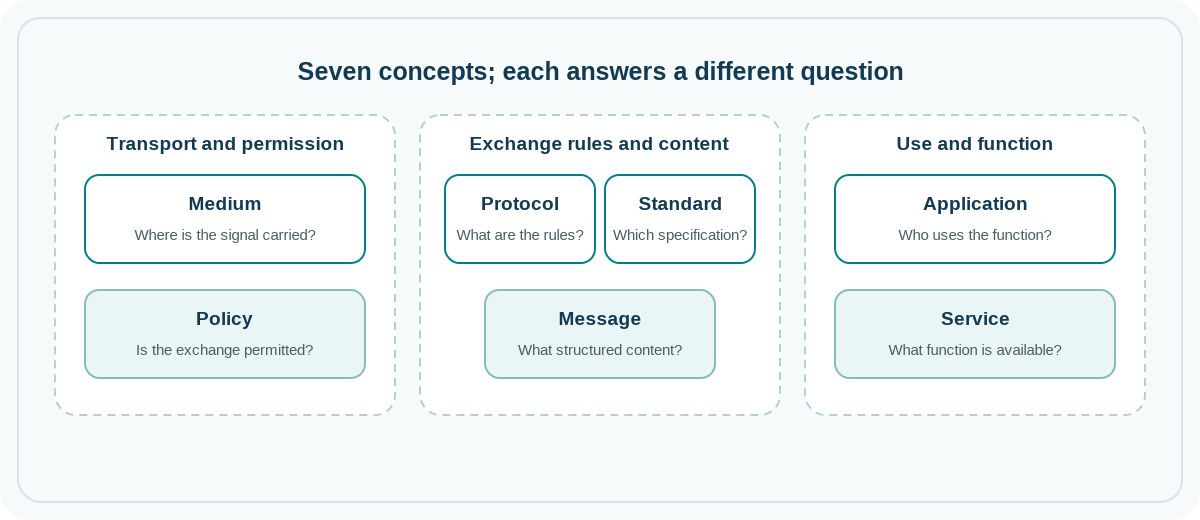
- Application: what does the user run?
- Service: what capability is offered?
- Protocol: what rules govern the exchange?
- Standard: what shared reference applies?
- Message: what meaningful unit is exchanged?
- Medium: where does the signal travel?
- Policy: what is allowed or denied?
A form, meaning and timing lens
Ask whether the message structure is valid, what its values and behaviour mean, and when a participant sends, waits or stops if the protocol specifies timing. This is a teaching lens, not a universal protocol definition or a replacement for the relevant specification.
The diagnostic evidence path
- Physical connection: the endpoints and medium exist; this does not prove that the medium is healthy.
- Active link: local evidence indicates a working link; this does not prove an application service.
- Understood exchange: a current message arrived and was interpreted; this does not prove the goal was met.
- Available service: the service accepts requests and responds; it may reject a request or fail internally.
- Successful task: the requested outcome occurred in that attempt; this does not prove permanent success for every service.
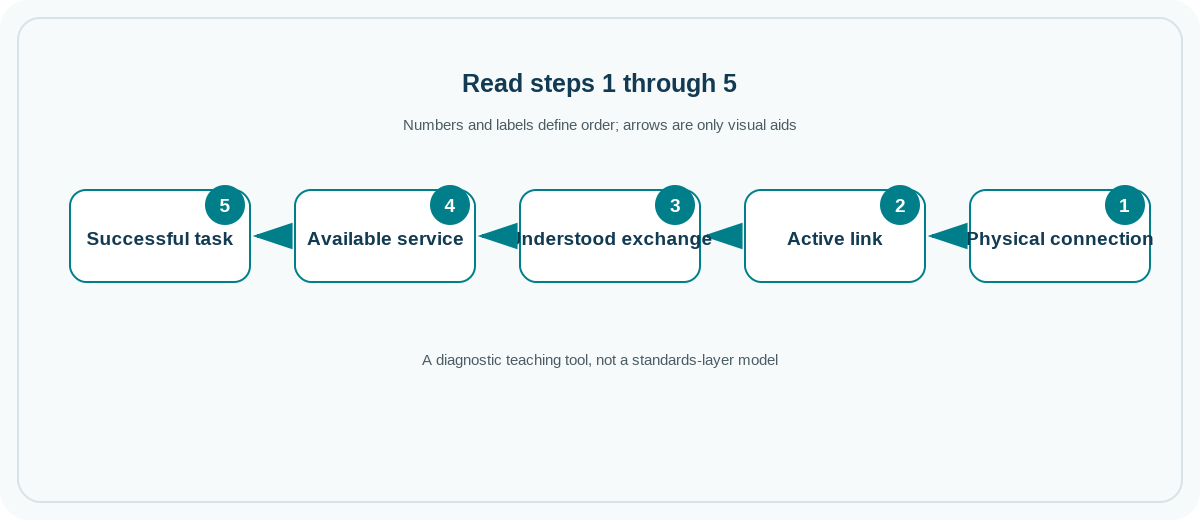
- Physical connection
- Working link
- Meaningful exchange
- Available service
- Successful task
A web request: one valid exchange, two outcomes
A client sends a current request to the intended service. If a response contains a valid error status and an understandable message, the protocol exchange succeeded while retrieval of the requested resource did not. RFC 9110 distinguishes status-class semantics; the presence of a response does not make every response successful.
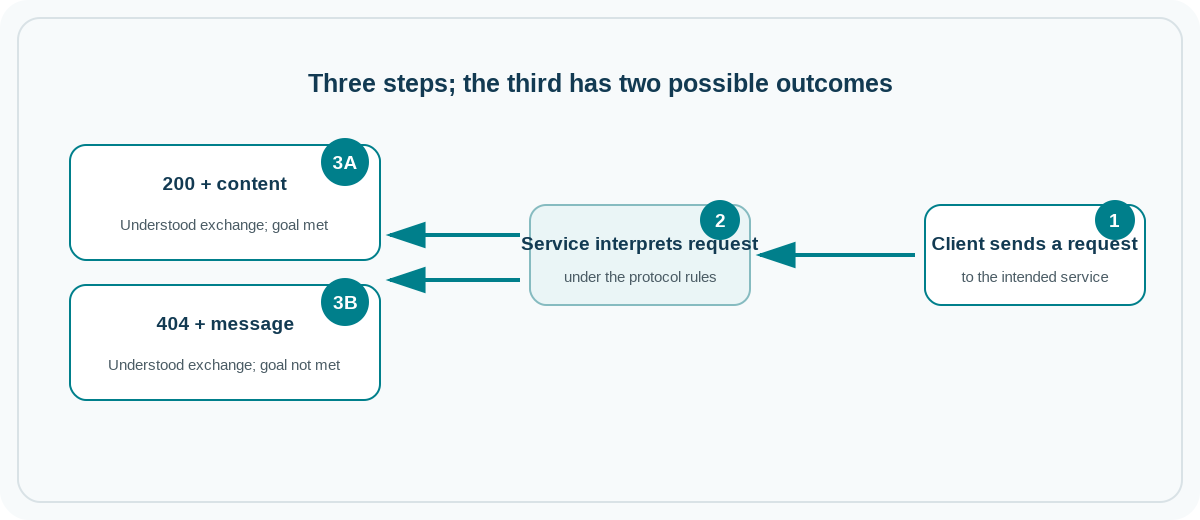
- The client sends a request
- The service returns a protocol-valid response
- Either useful content fulfils the goal or an understood error does not
Short scenarios and their limits
- A phone and access point from different vendors: compatibility depends on supported settings, policy and observed behaviour, not the vendor names alone.
- A printer produces no page: inspect the link, request delivery, service state, printer state and paper. Windows guidance is product-specific rather than a general standard.
- A cable is present but file sharing is disabled: replacing the cable cannot enable a disabled service; gather separate evidence for the link, service, policy and task.
Diagnostic exercise
Takeaway and the next lesson
Link operation, a valid message, service availability and task completion are different findings. The next lesson follows text through characters, bytes, bits, signals and media.
Quick review
- A phone joined an access point. Does that prove a web service is available?
- A current response says “resource not found.” What succeeded, and what did not?
- There is a printing program and a cable. Which concept describes each?
- The link is active but file sharing is disabled. Is replacing the cable enough?
- What is the difference between support, enablement and observed success?
Show the explained answers
- No. Only association or the local link has been established.
- An understandable message was exchanged; retrieval of the requested resource did not succeed.
- The program is an application; the cable is a communication medium.
- No. A medium cannot create a service that is not enabled.
- Support is capability, enablement is configuration, and success is an observed result in a stated context.