

Lesson
Lesson 8: Bits, bytes, encoding and signals
Learning goal
After this lesson, you can convert bits and bytes, calculate the UTF-8 bytes in stated examples, distinguish a zero byte from the character 0, a space and empty text, and explain how data relates to a signal and medium.
Why this concept matters
The text a user sees is not the electrical pulse, light or radio wave that carries it. Separating characters, encodings, bytes, bits, signals and media prevents mistakes such as treating a zero bit as no signal or a space as empty text.
Trace a representation from text to the medium
- Begin with the intended text and its characters.
- Identify the Unicode code points assigned to those characters.
- Encode the code-point values as UTF-8 bytes.
- Represent the bytes as a sequence of bits.
- Let the communication system map those bits to signals suitable for the technology and medium; reception interprets the sequence in reverse.
Core concepts
A bit is a binary value in a logical representation, and a byte in this lesson is eight bits. Unicode defines a character set and assigns code points, while UTF-8 encodes the numeric code-point values as variable-length byte sequences.
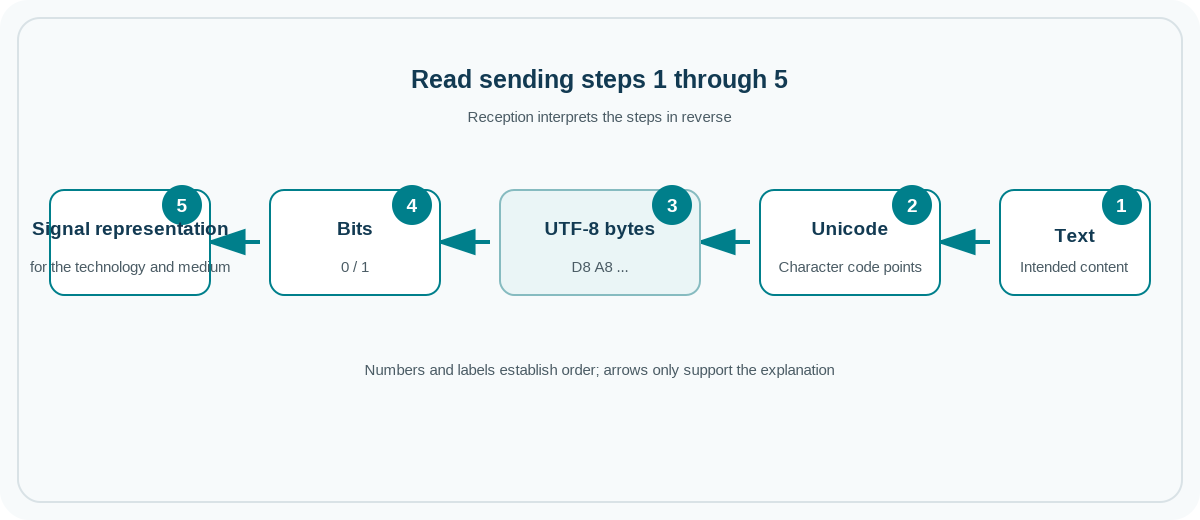
- Text
- Unicode code points
- UTF-8 bytes
- Bits
- Signal representation over the medium
Bits and bytes
1 B = 8 bit. The conversion changes the unit used to describe a quantity; it does not change the content or imply an improvement or loss in communication.
| Given | Operation | Result |
|---|---|---|
| 3 B | 3 × 8 | 24 bit |
| 5 B | 5 × 8 | 40 bit |
| 12 B | 12 × 8 | 96 bit |
| 32 bit | 32 ÷ 8 | 4 B |
| 80 bit | 80 ÷ 8 | 10 B |
| 10 bit | 10 = 8 + 2 | One complete byte and two remaining bits |
UTF-8 examples
These calculations apply to the exact raw text shown. A file may add a line ending, metadata or formatting, so the example size does not describe every file containing that text.
| Text | Unicode | UTF-8 bytes | Size |
|---|---|---|---|
| A | U+0041 | 41 | 1 B |
| AB | U+0041 U+0042 | 41 42 | 2 B |
| ب | U+0628 | D8 A8 | 2 B |
| باب | U+0628 U+0627 U+0628 | D8 A8 D8 A7 D8 A8 | 6 B |
Four different states
- Zero byte: the numeric value 00 is present in the data.
- Character 0: code point U+0030, encoded as 30 in UTF-8.
- Space: character U+0020, encoded as 20 in UTF-8.
- Empty text: length zero and no characters.
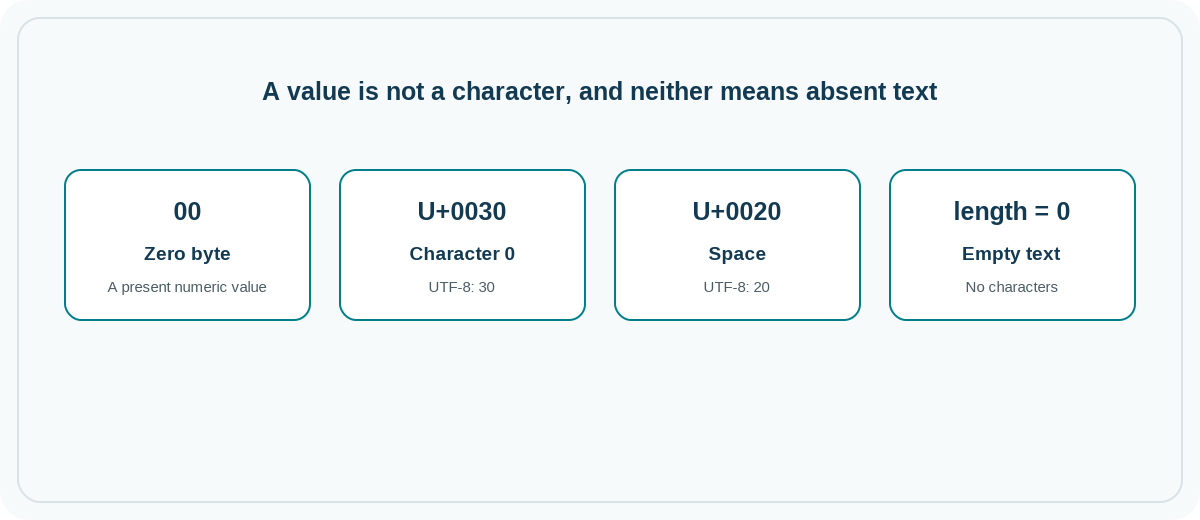
- 00: a bit pattern
- 0: a digit character
- Space: a character with spacing behaviour
- Empty text: no characters
Data, signals and media
Data is meaning or logical values. Encoding and modulation technologies represent data through measurable properties of a signal suited to a medium; this does not make every physical phenomenon a data signal. The medium is the physical support carrying that representation, such as a copper pair, optical fibre or a radio field.
A bit’s representation depends on the technology, medium and state. Zero therefore does not generally mean “no signal”; it may be a level, transition or symbol, and a signal may also carry timing and control information.
The same content over two links
The same intended bytes may be represented electrically over copper or optically over fibre. Identical content does not imply an identical signal, medium, transfer time or error rate. This is a conceptual comparison, not a measurement of a real network.
Diagnostic exercise
Takeaway and the next lesson
Characters, encodings, bytes, bits, signals and media describe different layers of representation. The next lesson applies the same precision to size, rate and transfer time.
Quick review
- Convert 5 B to bit.
- Convert 32 bit to B.
- What do eight zeroes in an eight-bit sequence represent?
- How many complete bytes and remaining bits are in 10 bit?
- What is the UTF-8 size of “A B”? The example is A, then a space, then B.
- On an optical-fibre link, what are the medium and signal type?
- If the content is only known to be 192 bit, is that enough to calculate transfer time?
- Do equal sizes for “AB” and “AC” mean identical content?
Show the explained answers
- 5 × 8 = 40 bit.
- 32 ÷ 8 = 4 B.
- One byte with the numeric value zero; the bit positions are present.
- One complete byte and two remaining bits.
- Three bytes: A, a space and B, or 24 bit.
- The fibre is the medium and the signal is optical.
- No. A content rate and other timing assumptions are required.
- No. The sizes are equal but the second character differs.