

Lesson
Lesson 9: Data size, rate and transfer time
Learning goal
After this lesson, you can distinguish b from B and MB from MiB, convert Mb/s and MB/s, calculate transfer time and interval averages, and distinguish nominal, observed, average and instantaneous rates.
Why this concept matters
Two numbers may look alike while one is a size and the other a rate; letter case can change bit to Byte. A valid calculation begins by reading the symbol, prefix and time basis, then aligning units and stating assumptions.
Name the quantity and unit before calculating
- Determine whether the value is a size, rate or time.
- Read case correctly: b for bit and B for Byte.
- Identify the prefix: MB is decimal and MiB is binary.
- Align the units before multiplying or dividing.
- State what the model includes and excludes, then interpret the result only within those limits.
Symbols and prefixes
BIPM defines the decimal SI prefixes, while NIST documents the binary Ki, Mi and Gi prefixes. Letter case is part of the symbol rather than optional typography.
| Symbol | Meaning | Value used |
|---|---|---|
| b | bit | A binary value |
| B | Byte | 8 bit |
| MB | megabyte | 1,000,000 B |
| MiB | mebibyte | 1,048,576 B |
| Mb/s | megabit per second | 1,000,000 bit/s |
| MB/s | megabyte per second | 1,000,000 B/s |
Unit conversion
40 Mb/s ÷ 8 = 5 MB/s, and 12.5 MB/s × 8 = 100 Mb/s. These are two units for the same rate under decimal prefixes; multiplication or division does not measure performance or prove a loss.
Size, rate and time
For a constant content rate and compatible units: transfer time = data size / content rate. Example: 90 MB / 10 MB/s = 9 s. This result belongs to the model and excludes waiting, negotiation and headers not included in the size.
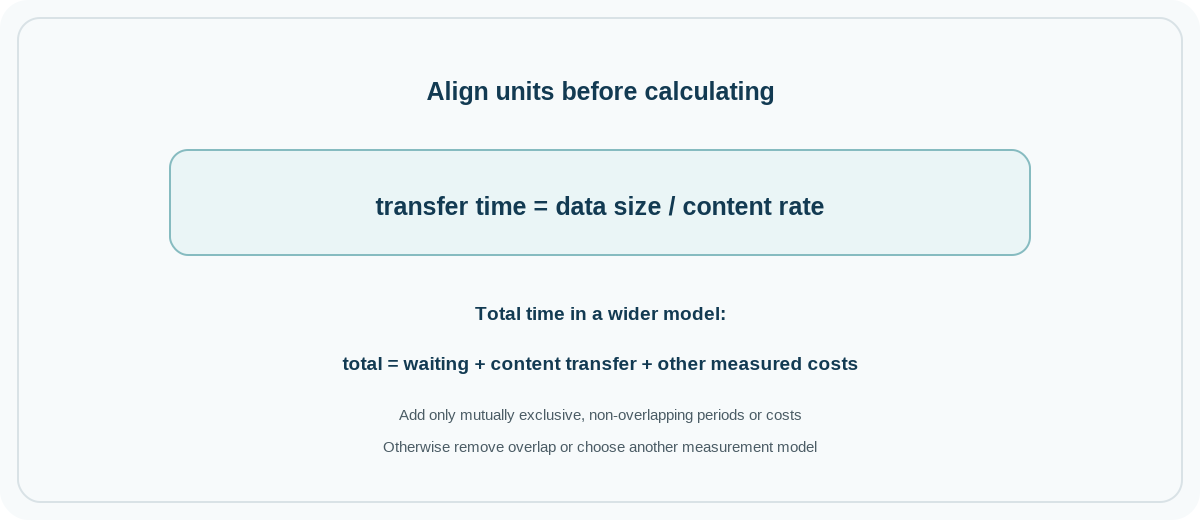
- Align size to bits or bytes
- Align rate to bits/s or bytes/s
- Transfer time = size ÷ rate
- Add only explicitly defined, non-overlapping intervals
For a binary/decimal example, 100 MiB = 104,857,600 B and 80 Mb/s = 10,000,000 B/s, so 104,857,600 / 10,000,000 = 10.48576 s. The value is exact for the inputs and assumptions, not a guaranteed download prediction.
The model total = waiting + content transfer + other measured costs is valid only when its terms are defined as mutually exclusive, non-overlapping periods or costs. Overlapping terms must not be added directly.
Measuring a rate
- Nominal rate: an advertised description or link/service bound, not necessarily application throughput.
- Observed rate: a quantity measured in a stated experiment, context and interval.
- Interval average: total content divided by elapsed time; it does not prove a constant value at every instant.
- Instantaneous value: a short-term reading that may change rapidly.
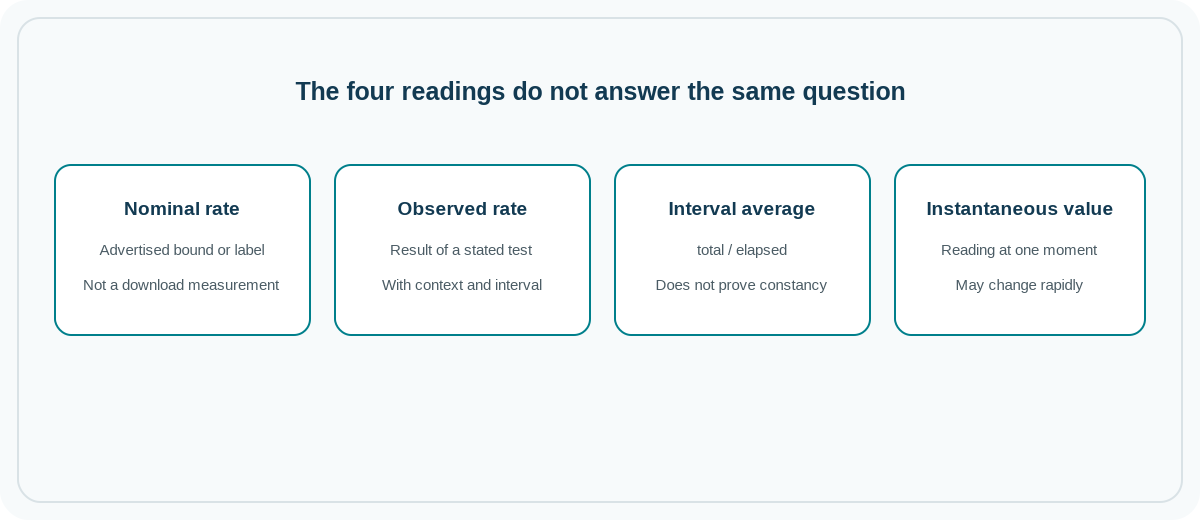
- Nominal rate
- Observed rate
- Interval average
- Instantaneous value
A valid average
If 8, 10, 14, 16 and 12 MB arrive over five one-second intervals, the total is 60 MB over 5 s and the average is 12 MB/s. This does not mean every second carried 12 MB.
For intervals of unequal duration, divide the total by total elapsed time or use an appropriate weighted average; do not take a simple mean of rates from unequal intervals.
Diagnostic exercise
Takeaway and the next lesson
Size, rate and time are different quantities; letter case and prefix are part of their meaning. A calculation is valid only within its units, assumptions and measurement limits.
Quick review
- Convert 40 Mb/s to MB/s.
- Calculate the time for 90 MB at 10 MB/s.
- Calculate the average for 50 MB over 5 s. Does it prove constancy?
- Are 100 MB and 100 Mb/s the same quantity?
- Convert 12.5 MB/s to Mb/s.
- Calculate the decimal time for 1 GB at 80 Mb/s.
- Compare 100 MB and 100 MiB in bytes.
- The nominal rate is 100 Mb/s and the observed rate is 8 MB/s. What does the difference prove?
- Calculate the average of 8, 10, 14, 16 and 12 MB over five seconds.
- Calculate the time for 100 MB at 100 Mb/s with an additional 2 s wait.
Show the explained answers
- 40 / 8 = 5 MB/s.
- 90 / 10 = 9 s under the constant-rate assumption.
- 50 / 5 = 10 MB/s; it does not prove an instantaneous constant rate.
- No. The first is a size and the second is a rate.
- 12.5 × 8 = 100 Mb/s; this is a unit conversion.
- 1 GB = 1,000 MB and 80 Mb/s = 10 MB/s, so the time is 100 s.
- 100 MB = 100,000,000 B; 100 MiB = 104,857,600 B.
- It establishes a difference after conversion, but does not identify the cause.
- (8 + 10 + 14 + 16 + 12) / 5 = 12 MB/s.
- Content transfer is 100 / (100 / 8) = 8 s; total time is 8 + 2 = 10 s.